
A brand strategy agency helps a business decide what it stands for, who it serves, and how it should be understood in the market. Its work creates a foundation for decisions about messaging, design, customer experience, and marketing. Understanding that role makes it easier to recognise when outside support is useful, what a good engagement should produce, and how to choose the right partner.
What does a brand strategy agency do?
A brand strategy agency connects business goals with a clear position in the minds of customers. It examines the organisation, its audiences, and its competitive environment, then develops choices about whom the brand should prioritise, what value it should promise, and why people should believe that promise.
That work is more than finding an appealing phrase. A positioning statement has to reflect something the business can deliver. If a company wants to be known for attentive service, for example, its customer support, onboarding, and communications need to support that position.
An agency also helps leadership make trade-offs. Trying to appeal equally to every audience often produces vague messaging. Strategy establishes priorities so teams can make consistent decisions without treating every campaign, product launch, or website update as a fresh debate about the company's identity.
The practical output is a shared direction, supported by reasoning rather than personal preference.
Strategy, identity, and marketing serve different purposes
Agency labels overlap, so the name alone does not tell you what a partner will deliver. A branding agency may offer research, strategy, design, and implementation, while another may concentrate primarily on visual identity. The scope matters more than the label.
These distinctions help clarify the work:
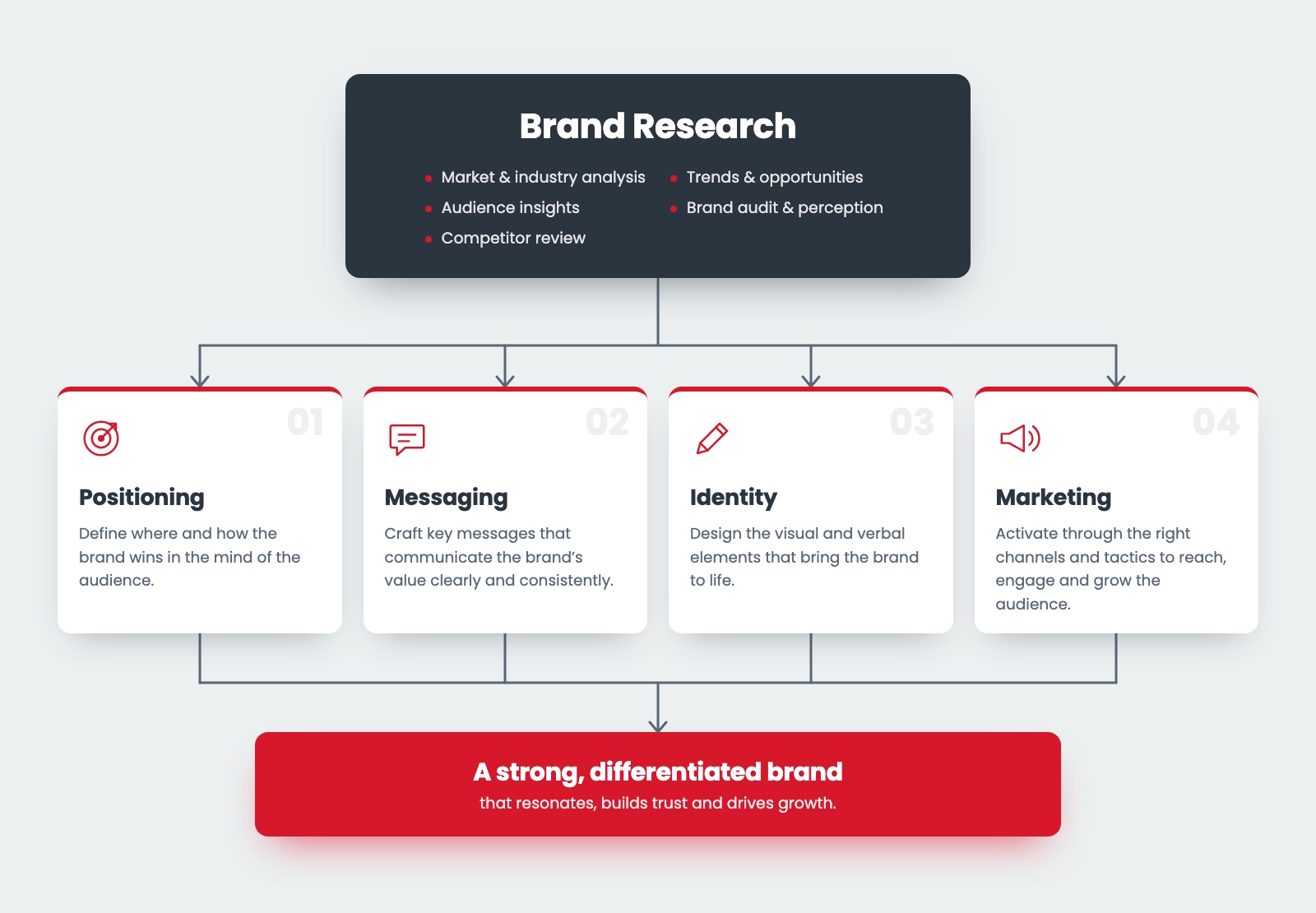
- Brand strategy: Establishes the audience, positioning, promise, and principles that guide how the business presents itself and behaves.
- Brand identity: Expresses that strategy through elements such as naming, logos, typography, colour, imagery, and verbal style. A brand identity agency typically focuses on making the brand recognisable and coherent.
- Marketing strategy: Determines how to reach and influence selected audiences through channels, campaigns, offers, and customer journeys. A marketing strategy agency may translate brand priorities into acquisition or retention plans.
- Brand development: Can cover the broader process of creating, refining, and introducing a brand. A brand development agency may combine several of these disciplines.
Consider a software company entering a new market. Brand strategy defines its relevant value and audience; identity expresses that position; marketing brings it to potential buyers. These activities should inform one another without becoming interchangeable.
The core work behind brand strategy services
Useful brand strategy services turn investigation into decisions that teams can apply. Deliverables vary, but the following areas provide a practical framework for discussing scope with an agency.
Research that tests internal assumptions
Research can include stakeholder interviews, customer conversations, reviews of existing materials, and analysis of competitors' messaging. Its purpose is to compare what the business believes with what customers experience and value. The agency should explain what its evidence supports, where findings are tentative, and which questions remain unanswered.
For example, a team might emphasise product features while customers consistently discuss ease of use. That difference deserves investigation before the company commits to a new message.
Positioning and a credible value proposition
Positioning identifies the audience, competitive context, relevant benefit, and reasons to believe. A useful value proposition explains why the offer matters without relying on empty adjectives such as “innovative” or “premium.” It should help the business articulate a meaningful distinction it can actually support.
The strongest direction is not necessarily the most dramatic. It is one the organisation can sustain across its products, services, and customer interactions.
Messaging and practical guidance
Messaging translates strategic choices into a usable narrative: what to say first, which benefits to emphasise, and what evidence supports each claim. Guidance may include audience-specific messages, voice principles, sample copy, or rules for describing products.
These resources should help people work, not merely fill a presentation. A sales team, website writer, and customer support lead should understand how the strategy changes their communication while preserving a recognisable brand.
A productive engagement moves from discovery to application
A strategy project needs both thoughtful investigation and a route into everyday use. Before work begins, the business and agency should agree on the problem, decision-makers, scope, and definition of completion.
A practical engagement might follow this sequence:
- Define the decision. Establish whether the business needs clearer positioning, a new audience focus, a portfolio structure, or another specific outcome. Avoid treating every concern as a complete rebrand.
- Gather and interpret evidence. Review available information, identify gaps, and conduct research proportionate to the decision. Separate customer evidence from internal opinions.
- Develop and evaluate options. Compare possible directions against customer relevance, credibility, distinctiveness, and business priorities. Explain why one option is recommended.
- Translate the chosen direction. Create messaging and guidance, then apply them to representative materials such as a homepage, sales presentation, or onboarding sequence.
- Assign ownership. Identify who maintains the strategy, approves exceptions, and coordinates implementation after the agency's involvement ends.
Internal participation matters throughout. Leadership must make choices, while frontline teams can reveal where a proposed promise conflicts with reality. A polished handover cannot compensate for unresolved disagreements about what the business intends to become.
How does brand strategy support a content agency becoming a brand media company?
For a content agency becoming a brand media company, strategy defines the audience relationship it wants to own, the editorial value it will provide, and how that publishing activity supports the business. The shift is not simply about producing more material; it requires a recognisable purpose beyond individual client assignments or campaigns.
A useful starting point is an editorial promise: who the publication serves, which problems or interests it addresses, and why readers should return. That promise should connect to the parent brand without making every article a sales pitch.
The operating choices then become clearer. The business needs to decide which topics it can cover credibly, what formats it can sustain, how editorial decisions are made, and where commercial relationships need disclosure. It also needs to distinguish audience-building goals from lead-generation goals.
Brand strategy supplies coherence, but it does not replace editorial judgement or distribution planning. A focused publication with a sustainable production process is a more realistic starting point than an ambitious content calendar unsupported by people, expertise, or resources.
How do you choose the right agency partner?
Choose an agency by how well its approach fits your business problem, the quality of its reasoning, and its ability to make the work usable. A visually impressive portfolio can demonstrate design skill, but it does not by itself explain research quality, strategic judgement, or implementation support.
Start with a brief that describes the situation rather than prescribing every answer. Explain what has changed, where decisions are getting stuck, which audiences matter, and what constraints the team faces. Share relevant existing research so the agency can propose work that fills gaps rather than repeats it.
Use conversations and proposals to examine the following:
- Problem understanding: Can the agency restate your challenge clearly and identify assumptions that need testing?
- Evidence and reasoning: Can it explain how research informs recommendations, including what happens when findings challenge leadership preferences?
- Working relationships: Who will do the work, who needs to participate internally, and how will disagreements be resolved?
- Scope and boundaries: Which deliverables, revisions, research activities, and implementation tasks are included or excluded?
- Practical adoption: How will employees learn to use the strategy, and what support is available during rollout?
Ask to see how an agency connected a strategic decision to actual execution, rather than requesting confidential client information. Discuss success measures before signing: clearer messaging, stronger internal alignment, or more consistent execution may be useful indicators. Commercial outcomes matter too, but avoid attributing every change in sales to brand work alone.
Make strategy a tool for everyday decisions
The value of brand strategy is not the size of the final presentation. It is whether the business can make clearer choices about its audience, promises, communication, and customer experience.
Before approaching an agency, write down the decisions your team cannot currently resolve and the evidence you already have. That simple exercise creates a stronger brief and helps distinguish a strategic need from a design or campaign task. The right partner should leave your organisation with a direction it understands, can deliver, and knows how to use.
Not sure where to start? Book a Brand Consultation and we’ll help you work out the right next step.
